投稿

Nobushige Hozumi: Born in 1855, at the age of 7 he studied at the domain school Meirinkan and achieved excellent grades. At the age of 16, he entered Kaisei School (the predecessor of the University of Tokyo) to study law. He graduated with excellent grades and upon graduating he went to England for three years to study legal systems on government funding, followed by two years at the University of Berlin in Germany. He returned to Japan in 1881 and became a lecturer at the Faculty of Law of the University of Tokyo, his alma mater, in charge of civil law. In 1882, he became a professor and dean of the Faculty of Law, and at the age of 33 became Japan's first doctor of law. He changed his university lectures to Japanese and switched to easy-to-understand lectures, and is nurturing many juniors. In 1891, the Russian Crown Prince, who was visiting Japan, was injured by a constable in the "Otsu Incident" (Nikolai Alexandrovich Romanov's attempted assassination in Otsu Town, Shiga County, Shiga Prefecture, when he was suddenly slashed and injured by a police officer, Sanzo Tsuda. In November 1890, when Nicholas II was crown prince (22 years old at the time), he left Russia to attend the groundbreaking ceremony of the Trans-Siberian Railway on behalf of his father, Russian Emperor Alexander III, and traveled to Egypt, India, and Sri Lanka. , Singapore, Vietnam, China, etc., and called at Nagasaki on April 27, 1891. In Japan, Prince Arisugawa, who had met the crown prince in Russia, welcomed him as an attendant. Preparations were meticulously made: he traveled through Japan to Nagasaki, Kagoshima, Kobe, Kyoto, Osaka, Nara, Yokohama, Tokyo, Kamakura, Atami, Nikko, Sendai, Matsushima, Morioka, and Aomori on May 31. He was scheduled to leave Japan on May 19. However, due to an incident, he ended up leaving Japan earlier than planned, on May 19, without stopping in Tokyo. It is a well-known story that Korekata Kojima (1837-1908), the Chief of the Supreme Court, asked for his opinion. Regarding the "Hozumi Bridge'', there was a growing trend to build a bronze statue to commemorate his achievements. It seems that he was refused because of the story. So, it seems that Hozumi Bridge was born with the approval of the teacher's name to be used for the bridge under renovation. The memorial was erected in July 1992. At the National University of Tsukuba, there is the “Hozumi book collection” by Professor Nobuhide Hozumi and his eldest son, Professor Shigeto Hozumi jurist. After studying at Daigaku Nanko(Location: One of the predecessors of the University of Tokyo, Kanda Hitotsubashi is located southwest of Ochanomizu where our school is located.)and Kaisei High School, he went to England and Germany in 1876. He earned the title of barrister at the Middle Temple in London and studied at the University of Berlin before returning to Japan. As a professor at the Faculty of Law, the University of Tokyo, he is in charge of legal science and English law. In 1893, as a member of the Code Research Committee, he drafted a civil code, and after that he worked on importing British and independent law, and was involved in many legislations. In 1890, he was elected member of the House of Peers for the first time. 1916 Privy Councilor.
イメージ
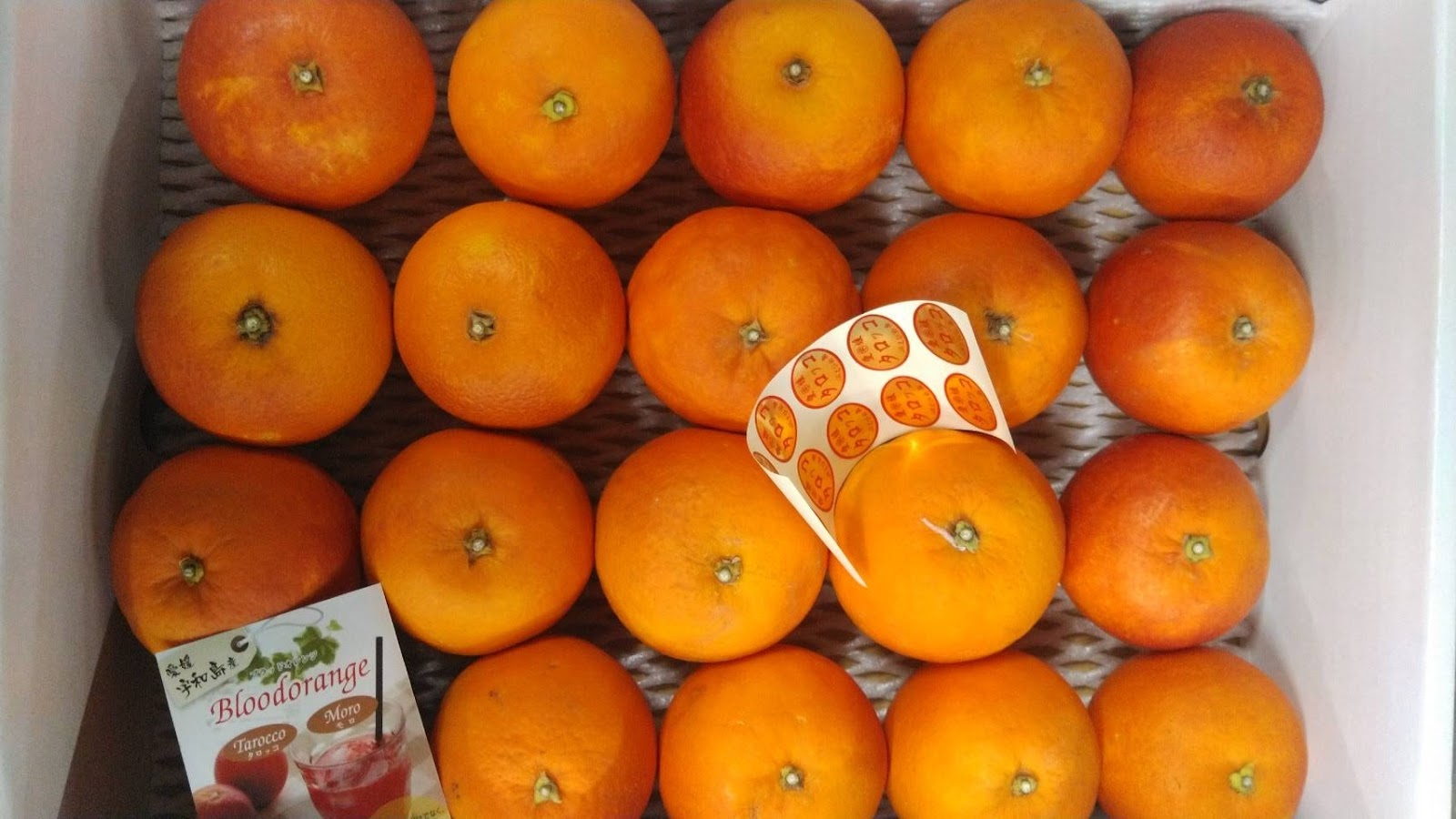
Tarocco oranges are said to have originated in Italy in the early 20th century from the blood orange variety Sanguinello Moscate. It is unknown when it was introduced to Japan, but he was introduced to Ehime Prefecture in 1973. A nuclear selection of Moscato Sanguinello obtained in 1949 at Acireale (Sicily, Italy) with the aim of establishing the type variety for subsequent geographic designation. Sanguinellos is one of three colored orange varieties native to Sicily, along with Tarocco and Moro. In fact, Tarocco appears to be an early mutation of the common Sanguinero. Is characterized by medium acidity (moscato is sweet, meaning Muscat) and is a highly valued colored orange, making it the most important Sanguinello variety in Sicily. A very vigorous and productive tree with long shoots forming a rounded, symmetrical crown. Medium-sized spherical fruit tending to have a flat apex. The rind is thin and smooth, bright orange with red pigmented areas. Melting flesh with red pigmentation ...

The Shiina clan separated from the Kammu Taira clan and the Chiba clan. In other words, it started when Tanetomo, the second son of Tanemitsu Shiina, lived in Node Village, Sosa County and called himself a fielder. When he died at the age of 75 in 1245, his sixth son and eldest son, Rokuro Michitane, succeeded him as lord of Node Castle, and his descendants are said to have continued as lords of the castle. In 1590, when the castle in Sosa County fell during the Battle of Odawara, it fell into ruin, abandoning the samurai and becoming a native. On the other hand, Taneyoshi's adopted son, Taneyoshi, ruled Ideno Township in Sosa County and called himself the Ideno clan. His son, Yoshinari, had distinguished himself in the 'Jokyu War' and was given Matsukura Township in Etchu Province, and his descendants moved to Etchu Province. During the Warring States period, the Shiina clan, which had the power to divide Etchu into two with the Jimbo clan, is said to be the flow. Yoshitame relied on the Node clan, and in 1469-86 Yoshitane, Kiyotane, and Moritane, who were members of the Shimousa Node clan, were 'expelled from Kamakura and languished in poverty'. He lived in Shimotsuma and became a vassal of the Tagaya clan. In December 1454, Kamakura public affairs Shigeuji Ashikaga (1438-1497) murdered Kanto Kanrei (shogunal deputy) Noritada Uesugi (1433-1455), who was in conflict with him, and was ordered to hunt down and kill him by the shogunate in Kyoto. Shogun Yoshimasa ASHIKAGA ordered Noritada IMAGAWA, the military governor of Suruga Province, to attack Kamakura, and Kamakura public affairs Shigeuji fled to Koga in Shimousa Province. Shogun Yoshimasa tried to put his brother Masatomo in public affairs on his behalf. However, due to the deteriorating situation in the Kanto region, he was unable to set foot in Hakone, and in the end set up a hall in Horikoshi, Izu, and called it 'Horikoshi public affairs.' Yoshitane, Kiyotane, and Moritane, who were vassals of Shigeuji Ashikaga during the 'Kyotoku War', are thought to have followed Shigeuji toward Koga. However, he was unable to head to Koga in the midst of the turmoil, so he took a detour to live with Shimotsuma's Tagaya clan and became a vassal.

イメージ
Chiba Prefecture's 99th commemorative castle stamp "Horikawa Place" is on sale. Hoshinomiya Shrine in the Horikawa district of Sosa City (4103 Horikawa, Sosa City, Chiba Prefecture: The establishment and other details are unknown. The enshrined deity enshrines Ame no Minaka Nushi no Kami. In the precincts of the site of 1,013 units of land measurement, there is a main hall (zinc It is said that the area around the former Nosaka town was the home of Tanetomo, the second son of Tanemitsu Shiina, who was a member of the Chiba clan. It was built on the site of Horikawa Place. The second son of Emperor Gohorikawa ruled over this land since 1242, and Horikawa Place is the residence of the Horikawa clan, a branch of the Chiba clan.)The site was used from the Kamakura period to the Sengoku period. It is speculated by historians that during the Sengoku period, the clan was attacked by the Node clan, and the Horikawa clan died in battle and died in a spectacular manner. 【Product na...

Chogyu Takayama (1871-1902: born in Tsuruoka City, Yamagata Prefecture), a literary figure in the early Meiji period, entered the literary world with the novel "Takiguchi Nyudo" (1894), and seems to have started a vigorous critic and literary activity thereafter. After studying abroad in Europe, which was just around the corner, he was offered a professorship at Kyoto University, but died at the young age of 31 in 1902, two years after he began to fight against pulmonary tuberculosis. Scenicloved the scenery of Kiyomigata in Shimizu Ward, Shizuoka City, and stayed there several times. Chogyu in Kiyomigata, Tokyodo bookshop (November 1905): At the beginning of April I left Atami and visited the historic site of Kiyomigata. It was an evening when the wind rustled in the pine grove in the distance and the sound of the waves sounded like a quiet thought. I left the inn alone and took a walk through Miho no Matsubara. The setting sun lingers only slightly in the clouds, but the moon has not yet risen. Tago no Ura song (Urawa) is during the evening calm, but there are almost no plovers. After passing Ejiri and Shimizu, you can see the ring tower of Ryugeji Temple on your right. The wind that blows down from the mountains enters my sleeves, and as I ride it, I hear the bell that signals the arrival of dusk, and the loneliness of early spring is all the more. By the time we arrived at Miho, the moon had finally risen, and the mist from the Kiyomigata Lagoon covered the crossroads on the far opposite shore, and the high roots of Mt. Fuji were white with snow. If you look around, the pine forest in the area is densely covered with trees. Even the color of snow, the color of the moonlight leaking through the swaying trees, was faintly misty and nothing could be seen under the trees. As the sound of the waves approached, I finally stood by the pine tree of angel's raiment. The Angel's Raiment Pine was something I had been longing to see for a long time. Alright, now let's spend the night with the moon. The pine tree has long since dried up, leaving only the bark of its trunk. There was a stone monument under the tree, but the light of the moon was weak and I couldn't make out what was written. The only thing that hasn't changed since then is the sound of the waves and the pine breeze. I cried all through the night in the shade of the pines. I don't know why. I couldn't stop the tears from flowing when I thought that I was crying all alone in Miho no Matsubara in Suruga. Even if I cried, who would feel sorry for me? The koto in my heart echoes with the helpless loneliness of a wild goose separated from its flock in the vast heaven and earth. This thought made me cry. When I think about the past, I also had an Amatsu maiden (lover). But the maiden was not a sincere person. Then her heart was ripped open by her floating thoughts, leaving her with a wound that could never be healed. All happiness left me and never came back.

イメージ
Saga Prefecture, Karatsu City, and JA Karatsu work together to fully support new farmers (benefits and incentives). A typical example of this is the Karatsu Agri-Training program, in which even inexperienced farmers can feel at ease in farming by spending two years working with host farmers to learn cultivation techniques, management know-how, and how to interact with the local community. In addition, we are also focusing on implementing farming enlightenment seminars and short-term training. In addition, JA, municipalities, subcommittees, etc. are working together to create a list of idle farmland and used greenhouses so that they can smoothly start farming after receiving ugg training. In recent years, material costs have skyrocketed, and once you start growing strawberries, the initial investment is huge, and it requires a lot of effort in terms of management. In order to realize new farming, the fact that these expenses can be minimized is also the reality of the current region whe...